/govets-registered-small.png?width=150&height=57&name=govets-registered-small.png "govets-registered-small")
/govets-registered-small.png?width=130&height=50&name=govets-registered-small.png "govets-registered-small")
/GoVets-Favicon-96x96.png?width=40&height=40&name=GoVets-Favicon-96x96.png)
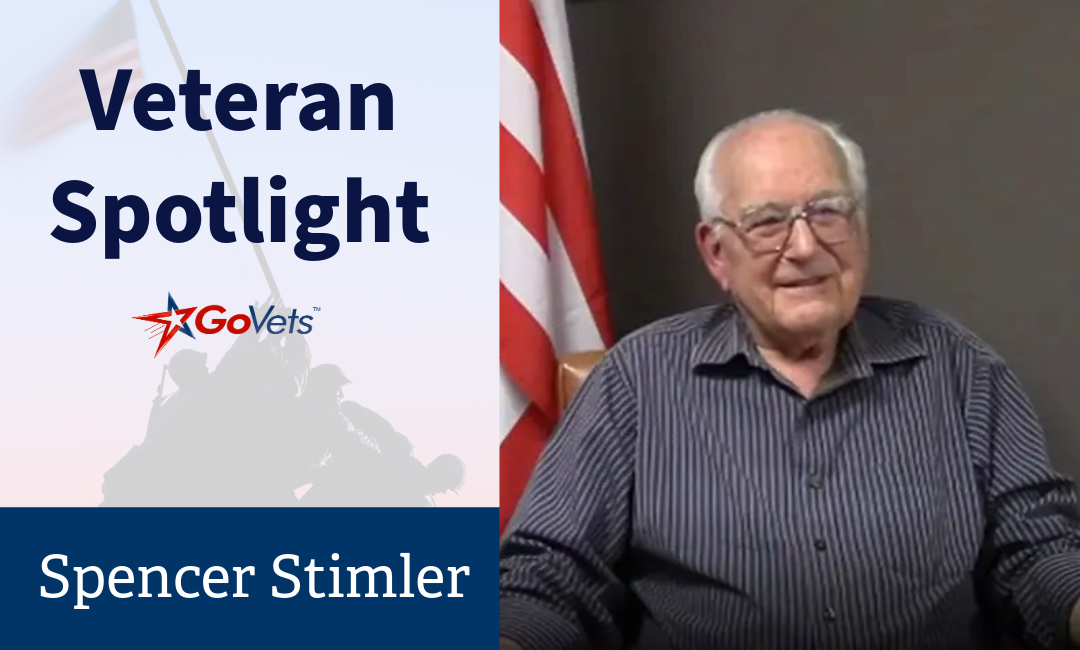
Veteran Spotlight: Honoring Spencer "Spence" Stimler
Today, we’re honored to shine a light on Central Coast World War II Veteran, Spencer “Spence” Stimler, whose remarkable story reflects courage, resilience, and dedication to service.
Spence served in the U.S. Navy from 1942 to 1946, earning the rank of Electronics Technician’s Mate 1st Class (SS). During World War II, he was assigned to the USS Pampanito (SS-383), where he worked as a radio technician from June 1944 until the end of the war in September 1945.
Born in 1923 in Minnesota, Spence enlisted in the Navy a year after graduating high school to avoid being drafted into the Army. Although his dream was to become a Naval Aviator, a medical condition prevented him from flying. When asked by a recruiter if he enjoyed math, Spence’s enthusiasm led him to take the Eddy Test—an assessment used to identify candidates for advanced electronics training in the Navy and Marine Corps. Passing with distinction, he was promoted immediately to Petty Officer 3rd Class.
After completing boot camp at Great Lakes, Illinois, and several technical training programs, Spence was promoted to 2nd Class and sent to Pearl Harbor. From there, he traveled aboard the USS Proteus (AS-19) to Midway and joined the Pampanito’s crew, qualifying in submarines in June 1944.
During World War II, the USS Pampanito completed six patrols in the Pacific, five of them with Spence on board. The submarine sank six Japanese ships and damaged four others. At the end of the war, the Pampanito returned to Mare Island, California, where it was decommissioned. Today, it is preserved at the San Francisco Maritime National Park, open to visitors for daily tours.
One of Spence’s most memorable experiences occurred during the Pampanito’s second patrol. The submarine sank the SS Rakuyo Maru, a Japanese ship unknowingly carrying British and Australian POWs. After learning the truth, Pampanito returned to the site three days later and rescued 73 prisoners of war—a heroic act that Spence remembered vividly. With 92 sailors already on board, the additional survivors made life aboard the sub incredibly cramped.
Years later, Spence shared a remarkable coincidence involving another submariner, Vic Radcliff, who served aboard the USS Guavina (SS-362). Meeting for the first time on an Honor Flight decades after the war, the two men discovered that they had witnessed the same Japanese tanker sink—Vic from the Guavina’s deck, and Spence through the Pampanito’s periscope—without ever realizing it at the time.
Spence’s lifelong connection to the submarine community continued long after his service. He joined SLO SubVets and received his Holland Club certificate from Base Commander Bob Baker on July 14, 2007—a distinction honoring those who qualified in submarines more than 50 years ago. In 2019, Spence was again recognized with his 75-Year Holland Club certificate, marking an extraordinary milestone of dedication and service.
We are deeply grateful for Spence’s contributions and for the sacrifices made by all who served.
Thank you for your service, Spence.

Power, Performance, and Patriotism: Milwaukee Tools on GoVets
Veteran Spotlight |Alton Roberts
No Comments Yet
Let us know what you think